dazeblog #6: what i make music with also 3 years no blogpost man wtf
talking about the gear that I use and why i’ve been away from the blogFirst off, real sorry about the absence from writing on here. I received messages all the time from you guys asking for more entries and I just wasn’t able to find either the time or the drive to sit down and write. Life got crazier in the last 3 years, in mostly great ways. Rest assured though, I’m back and I’m locked in. I’ll fill you guys in on the past 2.5 years as the entries go on.
Talking about Music Software
So with entry number 6, I wanted to give a little writeup on all the stuff I use to I make my music nowadays.
I’m very loyal to FL Studio. I’ve been using it since I was a wee lad (around 12 years old), on my dad’s Dell tower & my mom’s Dell Dimensions computer.
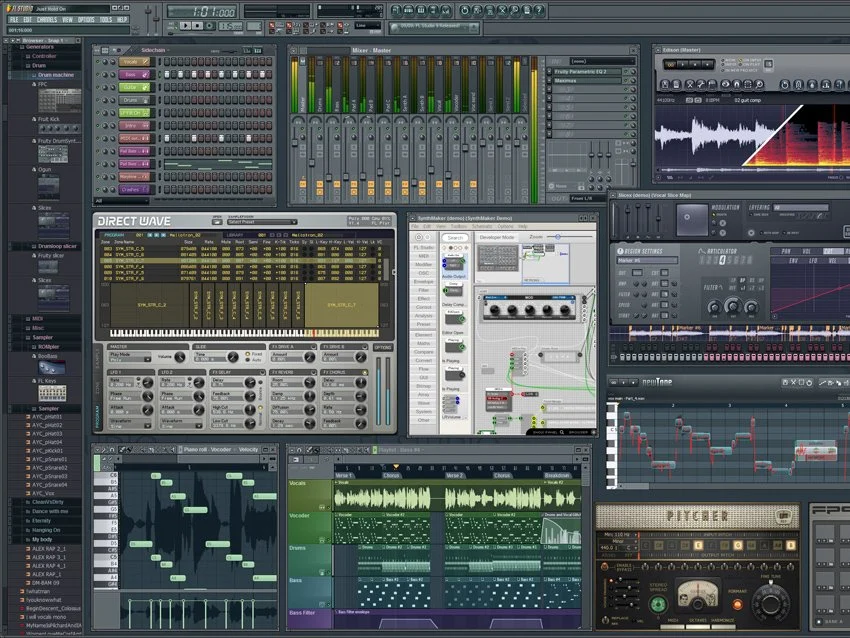
FL Studio 10, the first version of Fruity Loops that I ever used (photo by Sound on Sound).
I discovered it after seeing in the YouTube description of this one remixer/mashup artist I used to listen to back in the day, and I figured it was time to size up from the Android Tablet and use what the average producer did.
I’ve tried other DAWs and tools but in all honesty, my dexterity with FL Studio is stronger than any other program. It’s not like I’m incapable of using other DAWs but I feel that FL Studio’s workflow is fairly well streamlined and most of the time it’s easy for me to get what I want done with it.
Before the rest of the article, I need to say that it really doesn’t matter what you use. If you’re beginning in music production, I recommend just find what software you think looks and feels the best and take it from there.
VSTs I use as of 2026
Right now, I use Zenology, Purity, Serum 2 & Nexus 5, Hive, & Hybrid frequently.
Each of them have their own quirks with it but I’ll just write quick blurbs for each to save us the time.
Zenology: More Roland sounds than you’ll know what to do with.
Purity: Plugg, probably most producers first brush with ROMplers. Easy to work with but there is a clear limit to it.
Serum 2: Has the original Serum’s capability of synthesizing any and everything you’d want but turned up to the max and another oscilator to fuck with.
Hybrid: A feature rich synthesizer, has a nice collection of presets to work with, modifying & making your own sounds is as easy as other VSTs.
Nexus 5: I just use the Nexus 2 sounds, everything new they added kind of fuckin sucks.
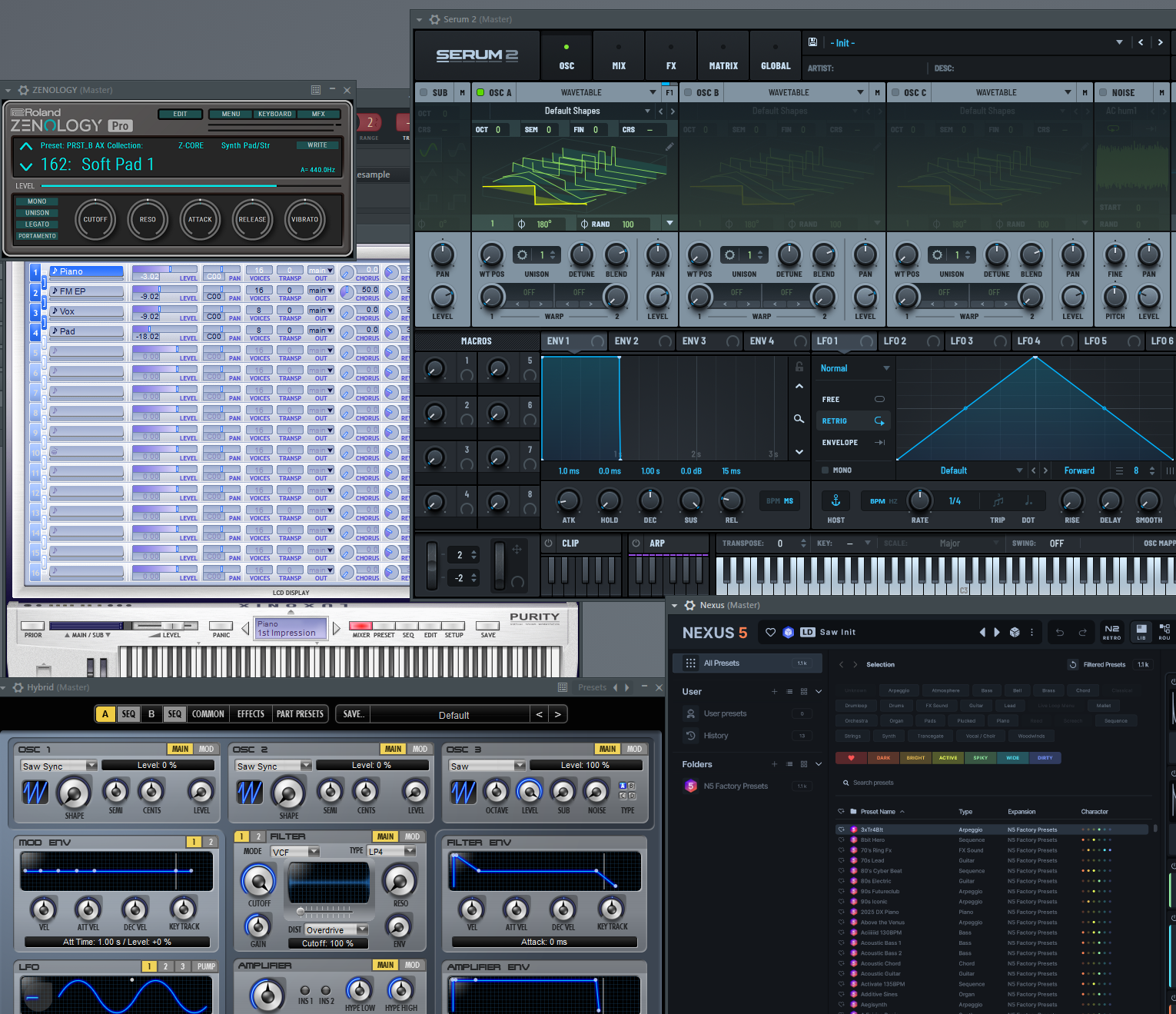
(Not pictured, Hive)
For effects, I have the Camel Audio (CamelPhat, CamelCrusher, CamelSpace) plugins before Apple bought them out, Output Portal & Thermal, Cableguys’ Shaperbox 3, Arturia’s FX Collection 5 and Slate Digital’s FX plug-ins.
For mixing, I stick to the FabFilter Plugins and FL Studio stock plugins (because they do the job just as well).
For mastering (if i don’t outsource it), I close my eyes and let Ozone 11 presets do most of the grunt work.
The reason I’m breezing through those section is because I want to talk more about-
My Hardware and My Rackmount Rig
Before this section I’d like to preface with a bit on why I have hardware.
I just think the bleeps, bloops and buttons are fun. I love collecting & using older technology; even beyond the realm of music but its nice to work my love of that into my craft.
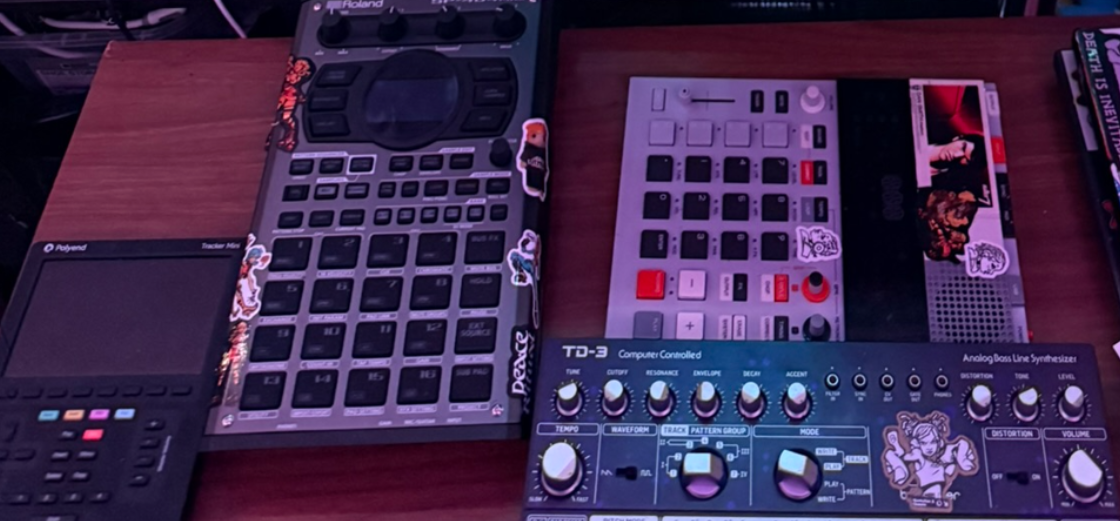
My current rotation of gear (Left to Right: Polyend Tracker Mini, Roland SP 404 MKII, Behringer TD-3, Teenage Engineering K.O. II)
Now first, my outboard gear.
I have a Polyend Tracker Mini (purchased off of Swami), a Teenage Engineering K.O. II, a Behringer TD-3 & an SP-404 MKII. I use each of these on a “when I feel like it” basis. These are all more modern interpretations of prior technology.
The Polyend is a handheld take of tracker software like ProTracker & Renoise, with a very easy on the hands formfactor and interface. I like using it to get quick ideas down on flights and bus rides.
The K.O. II is the first sampler that I purchased after making the Vita Sampler (see blog entry number 4). It’s best use case for me right now is as a soundboard for DJ sets, but its very capable for controlling other gear and arranging full songs with.
The Behringer TD-3 is a 0.9999:1 lone of the TB-303 from yesteryear and it what I like using to get acid basslines in my tracks. I think its more fun than using software emulation cause of all the knob controls possible. It’s the oldest one in my collection, I’ve had it since 2023 its sick.
The SP-404 MKII is the most recent purchase of mine in terms of gear and there’s nothing I can tell you about it that a million other producers couldn’t tell you better. It’s a strong sampler/groove box/effects board and is a much needed revision from the 404SX.
Currently the outboard gear I have that’s collecting dust right now are my Arturia Microfreak and the Alesis SR-18. Don’t get me wrong both of them, are very decent products but I think I’d have more application with those two if I was more keen to doing live performances with hardware (or if I was a traditional musician as opposed to a DJ).
What I really want to spend most of this article on is my rack setup:
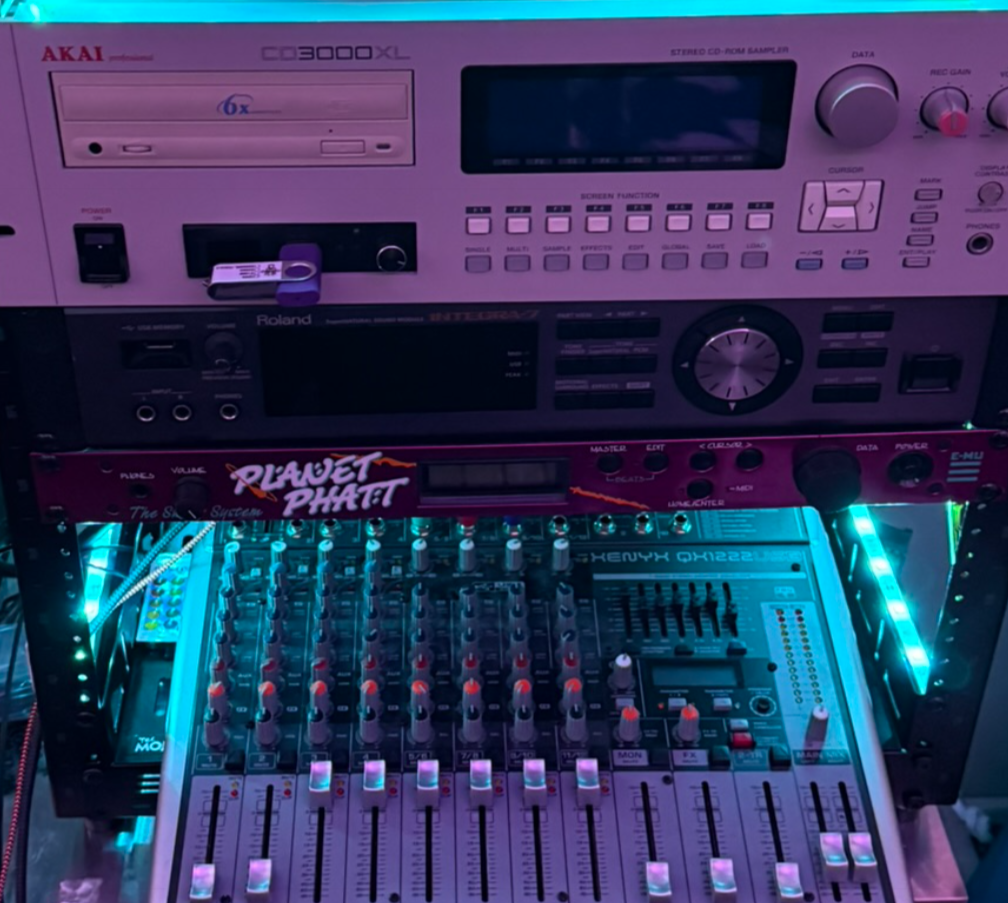
My ~$2000, 50LB bundle of joy.
Roland Integra-7 - Picked up around May ‘25 off Reverb for $1100
Longtime fans and followers of my Twitter are probably familiar with my aspirations of getting ahold of a real Roland JV-1080 or XV-5080. Well after a fairly successful year I was able to afford something better.
Released in 2012, the Roland Integra-7 is what I believe the peak of Roland’s family of rackmount modules. At the risk of sounding like an ad-read, I love the Integra. It’s extremely versatile for a multitude of genres and it has a rich library of sounds that go back to Roland’s heyday (so essentially it’s like every other Roland product released since then). It boots up relatively fast for gear of its era and is easy to get going with, especially since it has a USB interface built in that you can use without a midi & separate audio interface. For more (and better written) reading material on the gear, here’s a review from Sound on Sound from back around it’s release.
I used it on “don’t be stupid”, “watch this” and various other soon-to-be-released tracks. Working it into my regular workflow with FL Studio wasn’t too hard; I already had an external interface that was capable of sending MIDI and receiving audio (an SSL2+ MKII that I bought off Jane after the first tour ended). Now, there was more of a hitch-up using this over it’s technological descendants, like saving, composing multiple MIDI Out channels & finagling my way through the UI for the first few times but after working with it long enough, I felt better about using it frequently. It’s nice to use another box to process audio, since it lightens up some CPU load to handle stuff like post-processing effects.
This was the first of the rack modules I picked up, followed shortly by the AKAI CD3000XL.
AKAI CD3000XL - Picked up in July ‘25 off eBay for $500
If you know Jungle, you know how legendary and revered the AKAI sampler modules are. Pops up in many old documentaries, studio recordings, live performances, and every 3rd video on hardware prod youtube. When I realized that I might as well start building a proper rack for my home studio, I knew I’d get one.
Picking a model was tricky, because when you’re getting one of these modules you have to take into account the sound that you want. Each model from their sampler line up came with its own improvements, drawbacks and quirks. When I chose the CD3KXL, I chose it with the mindset of wanting a balance between audio quality, convenience and feature set.
Essentially the CD3KXL is the S3000XL with a built-in CD ROM drive and a lot more digital ins and outs. I’m not equipped to say much on the technical but here’s another Sound on Sound write-up from ‘97. BUT, I will speak on what I’ve done to it. You may notice in the picture of my rack that there’s a funky purple USB hanging out of it. That is a USB of Floppy Disk images with various samples, plugged into a GoTek emulator, courtesy of Bizzy B’s webstore. Now when I first got a hold of the module, I thought I’d just write some floppy drives but I quickly realized after trying that it was inefficient, antiquated & would be costly over time. The GoTek handles all the downfalls of the original floppy drive it was shackled with.
Using it was more of a challenge than the Integra, but I still get some nice tracks in with it. I think the technical limitations compared to something like Fruity Slicer, Slicex, Amigo and the like make me more intentional with how I sample and process things. The unit doesn’t have much memory but enough to get a good track together before the RAM fills up. Admittedly, I have yet to use it to compose a full song on but pieces of songs. I’m too used to the FL Studio workflow but I am making strides every day towards being able to use it to its absolute fullness. I primarily use it to record and time stretch break patterns to get a more “authentic” sound but its truthfully not hard to do with software tbh- i just like being extra.
This was also purchased in the same month as the Behringer XENYX QX1222, a line mixer/audio interface with some nice effects to it but ultimately I prefer to use outboard & software. It’s convenient to use to record elements when I have a handful of stereo inputs to work with, as opposed to plugging stuff in and out from my main interface one at a time. I do want to pick up a rackmount interface to keep things cleaner though.
E-MU Planet Phatt - Picked up in Nov ‘25 for about $350 off eBay
This one was me just being greedy, but I remember seeing it at the Rinse Studio back when I did a set with Brighter Days back in 2023. I was intrigued with what it was capable off but unfortunately I didn’t have much time to check it out. Thankfully, we have the internet and I saw some demos on YouTube and I heard how often it was used back in the day on tracks I recognized.
Using it so far is about the same as the rest of the modules. I think the sounds it has in it are able to hold up, considering how a notable amount of music today calls back to the 90s and 00s era of RnB and Hip-Hop. Beyond the beats function & there’s a decent amount of basses, synths, guitars & other instruments available that all have their own unique charms to ‘em.
I don’t have many words to write on it tbqh but that’s just cause I gotta use it more.
Here’s a demo of me using all of the rackmount gear & the SP 404 MK II in a live jam setting:
TL:DR- older music hardware is fun. Slower than digital but fun.
I didn’t mention the wires though. Cable management is alot, I find my self having an urge or need to buy another cable/adapter/cable managing accessory on a regular basis. And at times, suddenly the cable I need would be nowhere to be found.
Lastly, I want to give a quick run down on what I run all this with: my computer, speakers and headphones.
I’ve always used Windows for production, that was the only option for Fruity Loops back then up until FL 20. I’ve changed machines but currently I have a Ryzen 7 based computer with a 5070 for a multitude of uses but you can run FL on some of the lowest spec PCs you can find today. I have a pair of Yamaha HS5s running from the aforementioned Solid State Logic SSL2+ MKII. Now the Yamaha’s aren’t fantastic but they do a good job for me; they’re loud, flat and fit on my desk without much fuss. I can get a good feel of how they’d sound on larger/more professional club setups with speakers instead of headphones.
I’m more of a headphone guy as a result of living with my family for most my life. I recently upgraded from a 4 year old pair of Audio Technica M50X to Beyerdynamic’s DT 900 Pro X. I can get away with having a pair of open-back headphones thanks to being an adult in my own room and so far I think they’re neat and easier on my ears and head. They’re also really good for monitoring, which helps when I’m mixing. I hate how muddy my older tracks can sound but that was a result of me compensating for headphones with weaker or heavier bass frequencies.
And yeah, that’s all the stuff I’m using right now, I’ll make sure to make the blog entries more frequent. Feel free to email or DM me with suggestions on stuff to write about.